Quick Answer:
Capri is a name commonly associated with the beautiful Italian island of Capri, known for its stunning coastline, clear blue waters and elegant atmosphere. It is often used as a girl’s name and evokes beauty, charm and a sense of Mediterranean luxury.
The Capri meaning is closely connected to the Italian island of Capri, a famous destination known for its natural beauty, coastal views and timeless elegance. As a name, Capri has a stylish and modern feel that appeals to parents looking for something distinctive, memorable and inspired by nature.
Beyond its geographical connection, Capri can symbolize beauty, freedom and a relaxed coastal lifestyle. Its short pronunciation and sophisticated sound make it an appealing choice for a baby girl. Whether you are exploring Capri as a name, a travel destination or a word with cultural significance, its association with Italian charm gives it a special appeal.
What Does the Word Capri Mean?
Capri does not have just one meaning in every context. It is best understood as a proper name with strong geographical roots and several modern cultural associations.
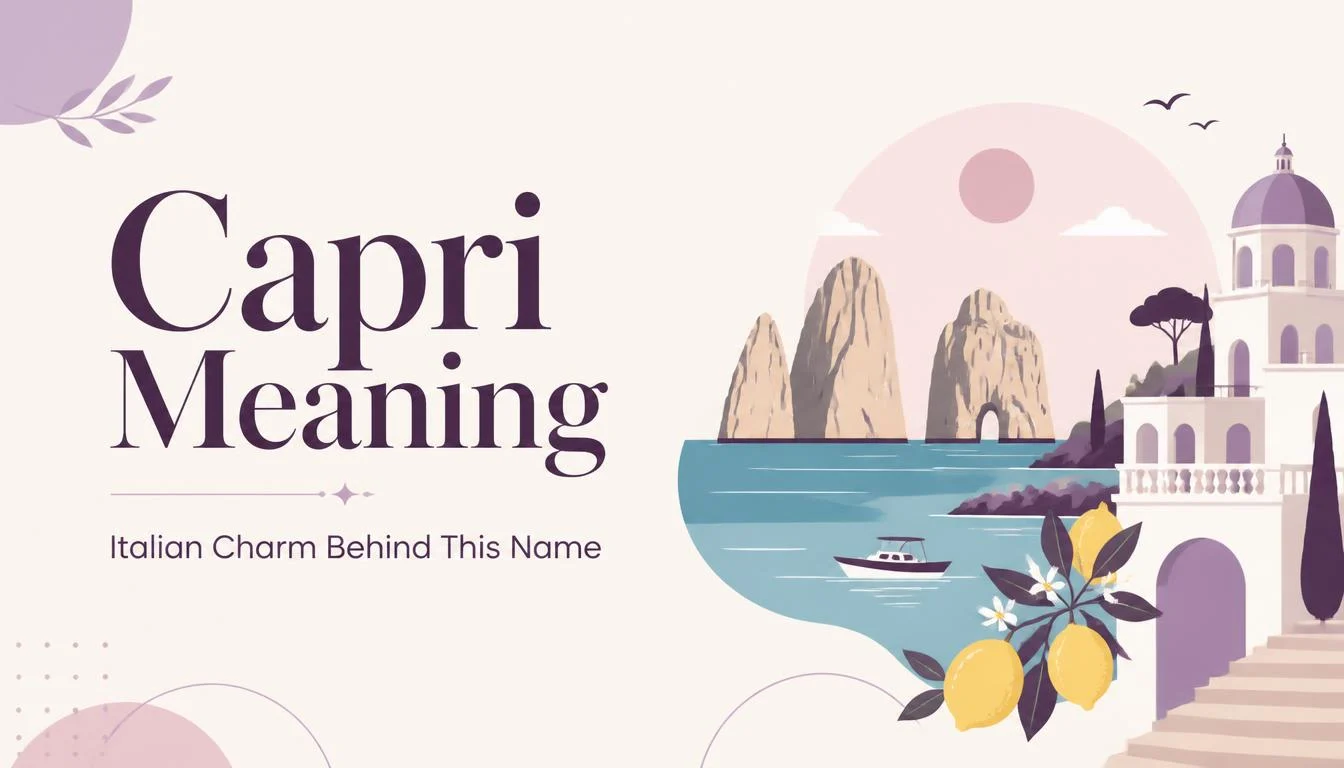
Its most established reference is the island of Capri in southern Italy. The island is famous for its dramatic coastal cliffs, clear blue waters, historic villas, and striking natural scenery. Over time, its name has become associated with Italian tourism, luxury travel, and Mediterranean style.
When parents choose Capri as a first name, they often appreciate these associations rather than seeking a literal dictionary definition. The name can suggest warmth, independence, beauty, and a relaxed but polished personality. These are cultural impressions, not fixed meanings or predictions about someone who bears the name.
The term also appears in clothing, most notably in Capri pants. These trousers generally end between the knee and ankle, although the exact length varies by design. Their name reflects a connection to the island’s popular image as a fashionable summer destination.
Is Capri a Word or a Name?
It can be both. Geographically, it is the proper name of an Italian island. In personal naming, it is a modern given name used primarily for its sound and associations.
Unlike a common noun with a straightforward dictionary definition, a place name may preserve a much older form whose original meaning is uncertain. That distinction matters when explaining the name’s history. The island’s identity is well established, but a simple translation of its ancient name should not be treated as settled fact.
The Origin and History of Capri
The history of the name goes back much further than modern baby-name trends or fashion. In classical sources, the island was known by forms such as the Latin Capreae and the Greek Kapríe or Kapréai. The classical archaeology collection of the Ignazio Cerio Museum on Capri connects the ancient name with the island’s goats and its pastoral history.
The precise etymology, or history of a word’s origin, is not universally agreed upon. One commonly mentioned explanation links the name to the Latin capra, meaning “she-goat.” Other proposed connections include the Greek kapros, meaning “boar.” These possibilities are discussed in etymological references, but they should be understood as theories rather than a single confirmed translation.
What Does Capri Mean in Italian?
Capri is the Italian name of the island. It is not generally used in modern Italian as an ordinary word meaning beauty, love, freedom, or paradise. Those ideas are associations people may attach to the destination, not literal translations of its name.
This distinction is especially useful for parents researching the name. A name can have a meaningful history without having a simple modern-language definition. Capri’s connection to an actual place gives it a sense of identity and heritage, even though its ancient linguistic roots remain debated.
How Did Capri Become a Symbol of Luxury?
The island’s reputation grew through its scenery, historic residences, and appeal to wealthy visitors. Its steep cliffs, sea caves, and secluded position made it attractive to Roman elites, including Emperor Tiberius, who developed a major residence there during his rule. Archaeological remains associated with Roman villas still provide evidence of this history.
In later centuries, Capri became a destination for travelers, artists, and writers. Its international image came to include stylish holidays, beautiful coastal views, and understated elegance. These associations eventually influenced how the name was used beyond geography.
Capri as a Personal Name
Capri is a distinctive modern given name that draws much of its appeal from the Italian island. It is used most commonly as a feminine name in contemporary English-speaking settings, although naming choices are personal and the name is not restricted to one gender.
Parents may choose it because they want something recognizable without being as common as traditional names such as Sophia or Olivia. Its two syllables make it relatively easy to pronounce, while its geographical connection gives it a recognizable cultural identity.
What Does the Name Suggest?
When used for a person, Capri often brings to mind several positive associations:
- Beauty: The island’s coastal scenery gives the name an attractive, picturesque image.
- Independence: Its distinctive sound can suit parents looking for a name that feels individual.
- Elegance: Capri’s association with Italian travel and fashion gives it a polished impression.
- Warmth: The island’s sunny Mediterranean setting encourages associations with summer and relaxation.
- Adventure: A place name can suggest travel, curiosity, and an interest in discovering new places.
These are subjective impressions rather than established personality traits. A person’s character cannot be determined by their name, and families may attach entirely different meanings to the same choice.
Is Capri a Rare Name?
Capri is less traditional than many long-established English first names, which can make it appealing to parents seeking a modern alternative. However, whether it qualifies as rare depends on the country, the year, and the population being considered.
For an accurate assessment in the United States, parents can consult the Social Security Administration’s baby-name data. The agency publishes annual records of names given to babies, allowing users to check rankings and historical trends rather than relying on informal claims about popularity.
It is also useful to distinguish a name’s familiarity from its frequency. Many people recognize Capri as an island or clothing term even if they have never met someone who uses it as a first name.
How Do You Pronounce Capri?
In English, Capri is commonly pronounced kuh-PREE, with the emphasis on the second syllable. Italian pronunciation differs somewhat, with the initial vowel and consonants sounding closer to the Italian original.
Because English speakers may be familiar with the name through travel, fashion, or television, pronunciation can vary slightly. For a child, that variation is unlikely to create major difficulties, although the family may need to clarify the preferred pronunciation occasionally.
Is Capri a Good Baby Name?
Capri may be a good choice for parents who enjoy place-inspired names, Italian references, and short names with a stylish sound. It feels contemporary without being an invented combination of unrelated syllables because it has a real geographical identity.
There are a few practical considerations, too. Some people will immediately associate it with the Italian island, while others may think of Capri pants or a brand that uses the name. If a family prefers a name with a clearly documented religious, linguistic, or traditional meaning, Capri’s uncertain ancient etymology may be less suitable.
Ultimately, the best reason to choose it is that its sound, history, and personal associations fit the family.
The Italian Island of Capri
The island itself explains much of the word’s modern appeal. Located in the Tyrrhenian Sea, near the entrance to the Bay of Naples in southern Italy, Capri is known for rugged coastal scenery, historic sites, and small towns with views across the water.
It is a real place with a long history, not merely a romantic image created by tourism. Its geography and surviving archaeological remains help explain why the name continues to carry such strong associations.
Famous Places That Define Capri
Several landmarks are especially closely connected with the island’s identity.
1. The Blue Grotto
The Blue Grotto (Grotta Azzurra in Italian) is a sea cave famous for its intense blue light. Sunlight enters through an underwater opening and illuminates the water, creating the striking effect for which the cave is known. The archaeological parks of Capri also document its historical association with a Roman imperial residence.
2. The Faraglioni
The Faraglioni are three prominent rock formations rising from the sea off Capri’s southeastern coast. They are among the island’s most recognizable natural features and frequently appear in travel photography. Their dramatic shape contributes to the association between Capri and Mediterranean beauty.
3. Villa Jovis
Villa Jovis is a major archaeological site associated with Emperor Tiberius. The remains illustrate the scale of Roman imperial building on the island and show how its cliffs and remote setting were incorporated into residential architecture. The site is an important reminder that Capri’s history extends beyond its modern image as a holiday destination.
4. Marina Grande
Marina Grande is the island’s principal harbor and a common arrival point for visitors traveling by boat. Its waterfront offers a different perspective from the dramatic cliffs and secluded caves. The harbor also connects Capri’s historic identity with its continuing role as a destination for travelers.
5. Anacapri
Anacapri is a separate municipality on the island, situated higher on its western side. It has its own historic center and access to panoramic views. The distinction between Capri town and Anacapri is useful because people sometimes use “Capri” to refer to the entire island rather than one specific settlement.
Why the Island Matters to the Name
A place name becomes more evocative when it is tied to recognizable scenery and history. Capri is a good example because its natural landmarks, ancient ruins, and international reputation provide a rich set of associations without requiring a literal definition.
For someone choosing the name, this connection may represent travel, family memories, or an appreciation of Italy. For someone learning the word, it explains why the term can suggest elegance even when the conversation is not about a person or a destination.
Capri in Fashion and Popular Culture
Capri is also widely recognized through clothing. The phrase Capri pants refers to cropped trousers that generally end around the lower leg, between the knee and ankle. Their name comes from the Italian island, where the style became associated with fashionable warm-weather dressing.
The clothing connection is particularly interesting because it helped carry the island’s name into everyday English. Someone might use the word without knowing anything about Roman history or Mediterranean geography.
How Capri Pants Became Popular
German fashion designer Sonja de Lennart is credited with creating Capri pants in the late 1940s. She developed a collection named after the island, drawing on its connection to her family’s holidays. The design offered a shorter alternative to traditional full-length trousers at a time when women’s trousers were still challenging established fashion conventions.
The style gained wider attention during the 1950s and 1960s. Film stars and television personalities helped bring it into mainstream fashion, with Audrey Hepburn and Mary Tyler Moore among the figures associated with its popularity. Moore’s character, Laura Petrie, wore cropped trousers in The Dick Van Dyke Show, helping make the style familiar to American audiences.
Capri pants have since returned to fashion at different times. Their exact cut can vary, but the name still evokes a lightweight, casual style suitable for warm weather.
Capri in Travel, Design, and Branding
The name also appears in travel businesses, hospitality, and product branding. Businesses may use it to suggest Italian inspiration, a relaxed holiday atmosphere, or a sense of refinement. These are marketing associations, however, rather than additional dictionary meanings.
A hotel called Capri, for example, does not necessarily have a direct connection to the island. The same applies to products and businesses that adopt the name. Their intended meaning depends on the individual brand and its history.
In popular culture, the word may also appear in songs, character names, fictional locations, and social media usernames. When you encounter it in one of these settings, the surrounding context is the best guide to its intended meaning.
Capri Compared With Similar Names and Terms
Several names and fashion terms share some of Capri’s associations, but their meanings are not interchangeable. The following comparison helps separate the geographical name from related naming styles and clothing categories.
| Name or termMain meaning or associationHow it differs from Capri | ||
|---|---|---|
| Capri | Italian island and modern given name | Has a specific geographical origin |
| Italia | Italian name for Italy | Refers to the entire country rather than one island |
| Roma | Italian name for Rome | Refers to Italy’s capital city |
| Siena | Italian city and given name | Has its own historical and geographical identity |
| Amalfi | Italian coastal town and name inspiration | Associated with another part of Italy’s coast |
| Bermuda shorts | Shorts named after Bermuda | Generally shorter than Capri pants |
| Cropped pants | General term for trousers cut shorter than full length | Describes a clothing feature, not a particular place |
Capri vs. Siena
Both Capri and Siena can appeal to parents who like Italian place names. Capri often evokes coastal scenery, summer holidays, and island life, while Siena is associated with the historic Tuscan city and its medieval architecture.
The choice comes down to the associations a family prefers. Neither name has a universally superior meaning, and both can be chosen for personal reasons that go beyond their geographical origins.
Capri vs. Bermuda Shorts
These terms are sometimes confused because both are associated with warm-weather clothing. The main difference is length: Capri pants usually extend down the lower leg, while Bermuda shorts typically end around the knee or just above it.
Their names also come from different places. Capri pants are named after the Italian island, while Bermuda shorts are associated with Bermuda and its clothing traditions. Both demonstrate how geographical names can become everyday fashion vocabulary.
Why Capri Remains Appealing
Capri has an unusual advantage as a name: it combines a short, memorable sound with a recognizable real-world reference. People can connect it with an island, a style of clothing, or a personal name without the word losing its identity.
Its appeal also depends on the way people attach meaning to places. An island associated with clear water, dramatic cliffs, historic villas, and stylish holidays can inspire positive feelings. Someone who has visited Capri may associate it with a personal memory, while someone who has never been there may picture it through photographs, films, or travel stories.
This is why the name can feel meaningful without having a definitive translation such as “beautiful” or “free.” Its significance comes from its history and the ideas people associate with it.
For parents, the same quality offers flexibility. Capri can feel modern and distinctive while retaining a real connection to Italian geography. For travelers, it names a specific destination with an identity that extends from antiquity to the present.
FAQs
1. Does Capri have a spiritual meaning?
Capri does not have one universally established spiritual meaning. Some people may associate it with peace, beauty, freedom, or personal renewal because of the island’s scenery and atmosphere. These are personal interpretations rather than a documented religious definition.
2. Is Capri mentioned in the Bible?
Capri is not a recognized biblical name or a standard biblical place name. Its documented historical associations are primarily connected with the Italian island and its ancient Greek and Roman history. Anyone looking for a name with a specific biblical meaning should consult established biblical name references.
3. What is the difference between Capri and Caprice?
Capri is the name of the Italian island and a modern given name. Caprice is a separate word and personal name associated with a sudden change of mood, impulse, or whim. Although the names sound somewhat similar, they have different linguistic histories and should not be treated as variations with identical meanings.
4. Can Capri be used as a boy’s name?
Yes. Although Capri is more commonly presented as a feminine given name in contemporary English-language naming, families can use it for a child of any gender. Modern naming choices are not strictly limited by traditional gender associations.
5. Is Capri an Italian baby name?
Capri is an Italian place name that is also used as a personal name. However, its use as a modern given name does not mean it has always been a traditional or widely used Italian first name. Its current appeal in English-speaking countries often comes from its geographical connection and distinctive sound.
Conclusion
Capri is a name with several connected meanings, from its ancient geographical roots to its modern use in personal naming and fashion. Its original etymology remains debated, but its identity as an Italian island is clear and well documented. Whether chosen for a baby, encountered in clothing, or discovered through travel, the word carries associations shaped by history, scenery, and culture. That combination of a real place and a distinctive modern sound is what makes Capri memorable.
Read More Related Articles:
- Safety Pin Necklace Mean | Why This Tiny Symbol Holds Big Meaning In 2026
- OBO Mean on Facebook Marketplace | Guide to Buying and Selling Smarter In 2026
- Outbox Mean in Email | Easy Explanation You Need In 2026

Michael Turner is a U.S.-based content writer and blogger who enjoys uncovering the stories and meanings behind words. Through his work at Meanvora, he delivers well-researched, easy-to-read articles that help readers expand their vocabulary and gain a deeper understanding of language.










1 thought on “Capri Meaning | Italian Charm Behind This Name In 2026”