Quick Answer
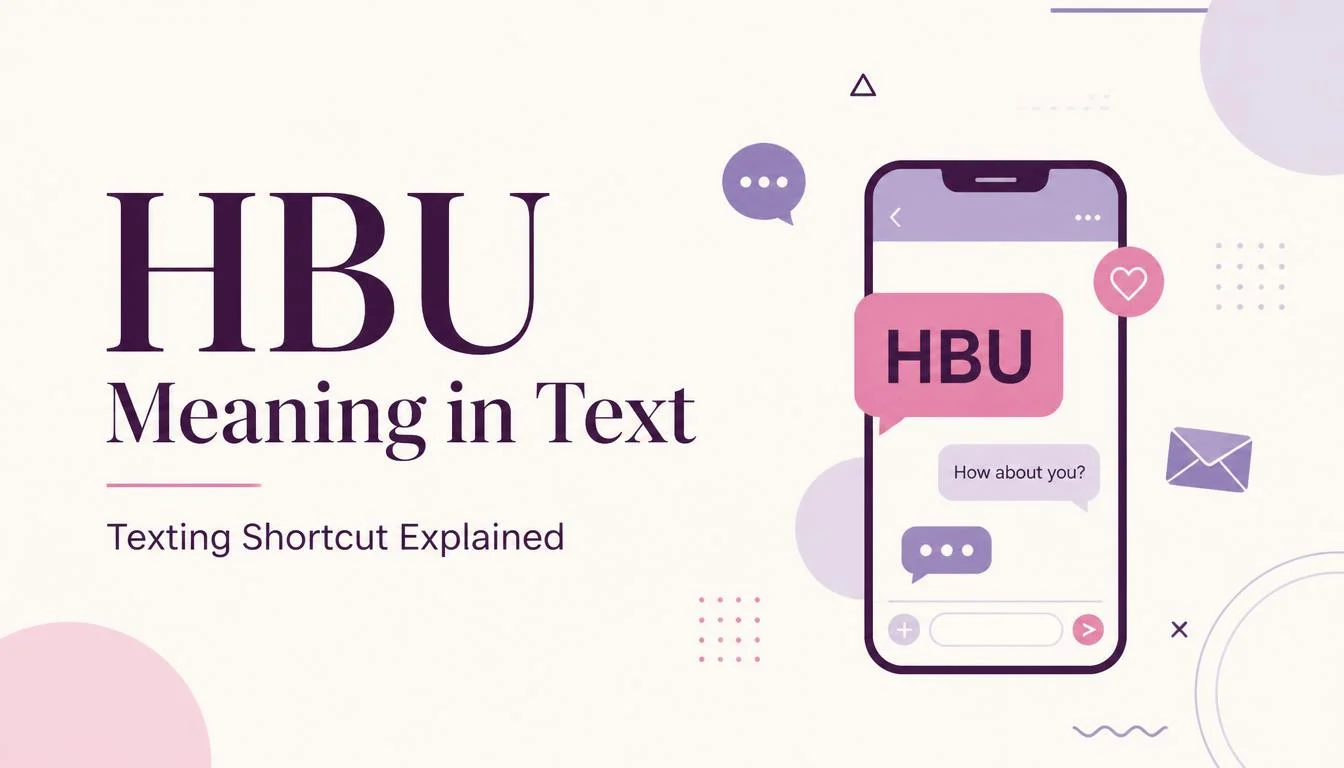
HBU means “How about you?” in texting and online conversations. People use it after sharing something about themselves to ask the same question back to the other person.For example, if someone says, “I’m doing great, HBU?” they are simply asking, “I’m doing great. How about you?” It is casual, friendly, and commonly used in messages on platforms such as Instagram, Snapchat, WhatsApp, TikTok, and iMessage.
If you have seen HBU meaning in text, you may have wondered what these three letters stand for. HBU is a common texting abbreviation that means “How About You?” It is widely used in casual conversations when someone wants to return a question without typing the full phrase.
Understanding HBU meaning in text can make online conversations much easier to follow. You may see it in text messages, social media chats and everyday online conversations. Its meaning is simple, friendly and usually depends on the question or statement that comes before it.
What Does HBU Mean?
HBU is a common texting abbreviation for “How about you?” It is usually used when someone wants to return a question without typing the full phrase.
Imagine a friend sends you:
“I’m staying home tonight. HBU?”
They are asking what you are doing tonight. The abbreviation keeps the conversation short while still sounding natural.
The letters come from the first letters of How, about, and you. Unlike some slang terms that can have several unrelated meanings, HBU has a fairly stable meaning in everyday digital communication.
You will usually see it in casual conversations. Friends, classmates, coworkers who communicate informally, and people chatting online may all use it.
The meaning is simple, but the tone can change depending on the conversation.
Why Do People Say HBU Instead of “How About You?”
The main reason is convenience. Text conversations often move quickly, so people shorten familiar phrases that are easy to understand.
HBU also fits naturally into a short message. Someone might write:
“I’m watching a movie, HBU?”
Typing the complete version would take only a few more characters, but abbreviations have become a normal part of casual online communication.
There is also a conversational reason for using it. HBU often signals that the person wants the conversation to continue.
If someone tells you, “My day was exhausting,” they could stop there. Adding “HBU?” turns the statement into an invitation for you to share your experience.
That small abbreviation can therefore make a message feel more interactive.
HBU Meaning Depending on the Conversation
Although HBU almost always means “How about you?”, the question can refer to different things depending on what came before it.
| Previous message | HBU is asking about | Example |
|---|---|---|
| “I’m good.” | How you are | “I’m good, HBU?” |
| “I’m from Texas.” | Where you are from | “I’m from Texas, HBU?” |
| “I’m going out tonight.” | What you are doing | “I’m going out tonight, HBU?” |
| “I love horror movies.” | Your preference | “I love horror movies, HBU?” |
| “I already finished the assignment.” | Whether you did it too | “I finished it, HBU?” |
This is why you cannot always translate HBU into one fixed question such as “How are you?”
The phrase means “How about you?”, but the subject of that question comes from the previous message.
That distinction matters when interpreting a text.
HBU in Different Types of Text Conversations
HBU is flexible because it can follow many ordinary statements.
Talking About Your Day
One of the most common uses is discussing how someone is feeling or what they have been doing.
“My day was pretty good. HBU?”
The other person is being asked about their day.
A shorter version might be:
“I’m tired lol, HBU?”
Here, the person is probably asking how you are doing.
Talking About Plans
HBU can also ask about someone’s plans.
“I’m going to the gym after work. HBU?”
In this case, the person is not necessarily asking how you feel. They are asking what you plan to do.
The context supplies the missing information.
Talking About Preferences
You might also see it after an opinion or preference.
“I love Italian food. HBU?”
That means, “I love Italian food. How about you?” In other words, the sender wants to know whether you feel the same way.
Getting to Know Someone
HBU can appear frequently when two people are learning basic things about each other.
For example:
“I’m 22. HBU?”
The person is asking your age.
Another example is:
“I live in Chicago. HBU?”
Now the question is about where you live.
The abbreviation stays the same while the implied question changes.
HBU Examples in Everyday Texting
Seeing the term in complete conversations makes its use much easier to understand.
Example 1: Checking In
Person A: “I’m doing pretty well today. HBU?”
Person B: “Same here. Just relaxing.”
Here, HBU means “How are you?”
Example 2: Weekend Plans
Person A: “I’m going to a concert Saturday. HBU?”
Person B: “Probably staying home.”
Here, it means “What are you doing?”
Example 3: Food Preferences
Person A: “I could eat pizza every day. HBU?”
Person B: “Honestly, same.”
The question is about food preference.
Example 4: School or Work
Person A: “I finished my project already. HBU?”
Person B: “Not yet. I’m almost done.”
The sender wants to know whether the other person has finished too.
Example 5: Getting Acquainted
Person A: “I grew up in Florida. HBU?”
Person B: “I’m from Ohio.”
Here, the question concerns where each person grew up.
These examples show why context matters more than the abbreviation itself.
Is HBU Friendly or Rude?
HBU is generally friendly and neutral. There is nothing inherently rude about it.
In fact, it often shows that someone wants to keep the conversation going. They have shared something about themselves and are giving you an opportunity to respond.
Still, tone depends on the surrounding message.
Compare these two examples:
“I’m having a great day! HBU?”
and:
“Fine. HBU?”
The first sounds warm and interested. The second may feel brief or slightly distant, especially if the conversation already feels tense.
The abbreviation itself is not responsible for that difference. The wording around it creates the tone.
Punctuation, emojis, capitalization, and the relationship between the people can also influence how a message feels.
Is HBU Casual or Formal?
HBU is very casual.
It works well in texts, direct messages, group chats, and informal online conversations. You might see it on Instagram, Snapchat, WhatsApp, TikTok, iMessage, Discord, or similar communication services.
It is less appropriate in formal writing.
For example, sending “HBU?” to a professor in a formal email would usually sound too informal. In that situation, writing the complete question would be more appropriate.
Instead of:
“HBU?”
a professional message could say:
“How about you?”
The meaning is identical, but the second version fits a wider range of situations.
HBU vs. How About You
There is no meaningful difference in basic meaning between HBU and “How about you?”
The difference is mainly style.
| Expression | Meaning | Tone | Typical use |
|---|---|---|---|
| HBU | How about you? | Casual | Texts and DMs |
| How about you? | How about you? | Neutral | Casual or professional |
| And you? | Asking the same thing back | Neutral | Conversation |
| What about you? | Asking for the other person’s answer | Neutral | Conversation |
| WBU | What about you? | Casual | Texting |
HBU is simply the abbreviated version.
If you are unsure whether an abbreviation is appropriate, spelling out the phrase is the safer choice.
HBU vs. WBU
HBU and WBU are especially easy to confuse because they are used in almost identical situations.
HBU means “How about you?”
WBU means “What about you?”
Both expressions return the question to the other person.
For example:
“I’m from Miami. HBU?”
and:
“I’m from Miami. WBU?”
Both ask about the other person’s location or background.
There can be a slight difference in wording, but casual texters often use them interchangeably.
The choice usually comes down to personal preference.
HBU vs. WYD
HBU and WYD can appear in similar conversations, but they do not mean the same thing.
WYD means “What are you doing?”
For example:
“I’m watching Netflix. HBU?”
This asks what the other person is doing if the context is about activities.
But:
“WYD?”
directly asks what the person is doing.
HBU is therefore a response based on something already mentioned. WYD is a standalone question about someone’s current activity.
That difference is small but useful when reading casual messages.
Can HBU Be Used in Flirty Conversations?
Yes. HBU can appear in friendly, romantic, or flirty conversations.
However, HBU itself is not a romantic or sexual abbreviation. Its meaning remains “How about you?”
The surrounding conversation determines whether the exchange is flirtatious.
For example:
“I’m single. HBU?”
That could be an ordinary question between friends. It could also be part of a romantic conversation.
Another example:
“I think you’re really cute. HBU?”
The second message has a more obvious romantic tone, but that comes from the statement before HBU.
This is an important distinction. Not every use of a casual abbreviation carries a hidden meaning.
Does HBU Mean “How Are You?”
Sometimes, practically speaking, yes.
If someone writes:
“I’m doing good today, HBU?”
they are effectively asking, “How are you doing?”
But HBU does not literally expand to “How are you?”
Its direct expansion is:
H = How
B = about
U = you
So the correct expansion is “How about you?”
The exact question you should answer depends on the previous message.
If someone says, “I’m feeling great, HBU?” tell them how you are feeling.
If they say, “I’m going to the beach, HBU?” tell them about your plans.
How Should You Reply to HBU?
The easiest way to answer is to respond to the topic that came immediately before the abbreviation.
If someone says:
“I’m good, HBU?”
you can reply:
“I’m good too!”
If they say:
“I’m staying home tonight, HBU?”
you might answer:
“I’m meeting some friends.”
If they say:
“I love sushi, HBU?”
you could say:
“Same! It’s one of my favorites.”
You do not need to repeat the entire question.
A natural response is usually short because the original question is short.
What Does It Mean When Someone Replies HBU?
When someone replies with HBU, they are usually returning the question to you.
For example:
You: “I’m from California.”
Them: “HBU?”
They are asking where you are from.
It can sometimes feel like a conversation shortcut because the person has not written a complete sentence. That is normal in texting.
HBU is often less about saving time and more about matching the informal rhythm of online conversation.
If the person uses other abbreviations such as LOL, IDK, BTW, or TBH, HBU will probably feel completely natural within that conversation.
Capitalization and Punctuation
You may see HBU written in several ways:
- HBU
- hbu
- Hbu
- hbu?
All of these can communicate the same idea.
Capital letters are common because abbreviations are often written in uppercase. Lowercase is equally common in casual texting, especially when someone normally types in lowercase.
A question mark is also common because the phrase functions as a question.
For example:
“I’m fine, hbu?”
is completely normal.
The capitalization does not usually change the meaning.
HBU on Social Media
The abbreviation appears naturally in short-form digital communication because social media conversations often favor quick responses.
On Instagram, someone might respond to a story with:
“Looks fun! HBU?”
On Snapchat, a friend might write:
“I’m bored lol, hbu?”
On WhatsApp, you could see:
“I’m free tonight. HBU?”
On TikTok, a comment or direct message might use it when someone is asking another person to share their opinion or experience.
The exact platform does not change the definition. The context still determines what the other person is asking.
When Should You Avoid Using HBU?
There are situations where writing the full phrase is better.
Avoid HBU when communicating in a highly formal setting, especially if the reader may not understand texting abbreviations.
For example, a job application, formal business email, academic paper, or official request generally calls for standard language.
Instead of:
“I enjoyed speaking with you. HBU?”
you would normally write the full phrase if it is appropriate at all.
In casual communication, however, HBU is perfectly ordinary.
The key is knowing your audience.
Why Context Matters So Much With HBU
HBU is an example of how texting language depends heavily on context.
The abbreviation does not contain enough information by itself to tell you exactly what the person wants to know.
Consider:
“I’m going tomorrow. HBU?”
What is the person asking?
They could mean:
Are you going tomorrow too?
But the earlier conversation could make the question about something else.
That is why reading the message immediately before HBU is important. The abbreviation acts almost like a conversational mirror. It sends the same topic back to the other person.
Common Mistakes With HBU
One common mistake is assuming that HBU always means “How are you?”
That interpretation works in some conversations, but not all.
Another mistake is treating HBU as a formal abbreviation. It belongs mainly to casual digital communication.
Some people also confuse HBU with WBU or WYD. These abbreviations are related because they can appear in similar conversations, but their expansions are different.
The simplest rule is this:
Look at the sentence before HBU. Then answer the same type of question for yourself.
That approach works in almost every ordinary conversation.
FAQs
Is HBU an acronym or abbreviation?
HBU is commonly described as a texting abbreviation or initialism. It is formed from the initial letters of “How about you?” Because people normally pronounce the complete phrase rather than saying the letters as a spoken word, calling it an initialism is more precise.
Can HBU be used by adults?
Yes. HBU is not restricted to teenagers. Adults also use common texting abbreviations when communicating casually with friends, family, coworkers, or other people they know well.
Is HBU outdated slang?
No. HBU remains understandable and useful in casual digital communication. Its popularity may vary between individuals and online communities, but the expression itself is still recognizable.
Can I use HBU in a group chat?
Yes. You can use it in a group chat when you want to return a question to the group or to the person you are talking with. If the question is directed at one person, mentioning their name can make your intended audience clearer.
Does HBU have a different meaning in texting?
In ordinary texting, HBU overwhelmingly means “How about you?” Unrelated interpretations can exist in specialized contexts, but casual conversations almost always use the common texting meaning.
Conclusion
HBU is a simple way to say “How about you?” in casual digital communication. It lets someone return a question without typing the full phrase, which makes conversations quick and natural.
The most important thing to remember is that the exact subject comes from the message before it. Whether someone is asking about your mood, plans, opinion, location, or preference, HBU usually means they want your answer too.
Read More Related Articles:
- “Soxer” Mean | Truth Behind This Confusing Term In 2026
- LWK Meaning in Text | Hidden Slang You’re Probably Missing In 2026
- WBU Meaning in Text | Secret Behind This Chat Shortcut In 2026

Michael Turner is a U.S.-based content writer and blogger who enjoys uncovering the stories and meanings behind words. Through his work at Meanvora, he delivers well-researched, easy-to-read articles that help readers expand their vocabulary and gain a deeper understanding of language.